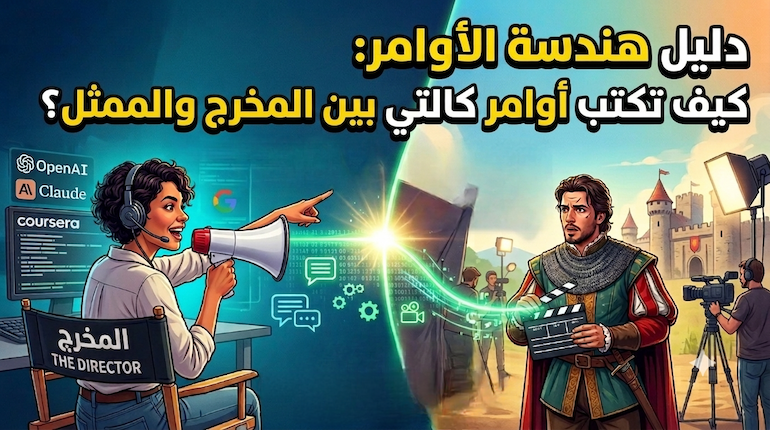
Prompt Engineering Guide: How to Write Prompts Like a Dialogue Between a Director and an Actor?
Have you ever asked an AI tool to write a cinematic scene or creative text without applying prompt engineering principles, only to get a dry, predictable result that reeks of “cheap automation”?
The reason is simple: you’re treating AI like a traditional search engine, when you should be treating it like a professional actor waiting for the director’s instructions. You can also check out experiments in creating fictional characters with AI to understand how to build a character and define its identity precisely before directing.
Generative AI applications today are no longer just digital tools for answering general questions—they’re an open stage requiring broad imagination and genuine sensory direction. The vast difference between an ordinary text that puts readers to sleep and a surreal text filled with vivid realism and detail lies in how well you master the concept of prompt engineering. Let’s learn how to transform from mere “data entry operators” into “film directors” of intelligent, impactful, and stunning texts that captivate readers and top search results.
What Is Prompt Engineering and Why Does It Resemble Film Directing?
In the modern AI world, the quality of text outputs doesn’t depend solely on the power of algorithms—it directly depends on the quality of inputs. This is where prompt engineering comes in as both an art and a scientific discipline focused on designing precise inputs that guide the machine toward producing high-quality, complex content.
Most major tech companies like OpenAI rely on developing language models capable of understanding complex context, but these models always need clear directional context to avoid generic answers. Additionally, advanced platforms like Anthropic Claude offer interactive models that accurately comprehend literary directions, while platforms like Coursera showcase specialized courses on how to master working with these programming models.
When you use the “director and actor” approach, you place the machine within a specific dramatic framework and impose creative boundaries that make the outputs highly unique—just like mastering video creation with AI, which requires precise direction of atmosphere and movement. A professional film director doesn’t just tell an actor “cry”—they explain the psychological state, internal motivations, and circumstances surrounding the scene to make the performance authentic and realistic.
Transform from Direct Commands to the Art of Prompt Crafting
Transitioning from writing simple prompts to advanced ones requires understanding the dimensions of the art of prompt crafting and how to build visual and psychological context. Most new users make the mistake of sending dry, short instructions, resulting in content lacking soul and creative detail.
| Comparison Point | Traditional Prompt Writing | Prompt Engineering with Director’s Approach |
| Goal | Get a quick, direct answer | Build a vivid experience with surreal/realistic details |
| Nature of Command | Dry instructions like: “Write an article about sadness” | Define character, lighting, movement, and internal emotions |
| Text Result | Generic text filled with repetitive clichés | Deep, structured text with a unique voice |
| Interaction | Single request relying on one answer | Ongoing dialogue and gradual prompt development |
Research and experiments in interactive AI show that writing detailed prompts that build spiritual and spatial context significantly increases the accuracy and quality of creative texts, distancing the text from the mechanical, formulaic style that search engines or professional readers might reject.
3 Pillars for Building a Stunning Cinematic Scenario
To get texts that combine realism and surrealism and master how to write a comprehensive prompt, you should always divide your written command into three main dimensions that closely resemble the elements of a cinematic scene:
1. Character Emotions and Internal Dialogue
Don’t ask the expressive model to write a final result—ask it to express the psychological state. Instead of using dry phrases, explain the character’s internal state:
- Ineffective Phrasing: “A person feels fear and tension in a dark place.”
- Directorial Phrasing: “Make the character breathe with a muffled sound, feeling as if the room’s walls are suddenly moving away and expanding. Their confusion between staying or fleeing shows in the tense movement of their fingers on the door handle.”
2. Scene Lighting and Surrounding Atmosphere
Light and shadow in the text determine the overall tone of the content and make the reader immediately imagine the place. You can use atmospheric directions to precisely adjust AI prompts for scenarios:
- Lighting Direction: “The atmosphere is cold and cloudy. The only available light is the flicker of an old screen hitting the right half of his face, while the other half drowns in complete, unknown shadow.”
3. Camera Movement and Visual Angles
Even if you’re writing a literary text meant only for reading, you can apply prompt engineering principles by using camera terminology to control sentence rhythm and narrative pacing:
- Lens Direction: “Start with an extreme close-up on a drop of sweat slowly falling from his forehead, then pull the lens back to a wide shot to reveal to the viewer that he’s standing alone in the middle of a completely silent and dark celebration hall.”
Practical Guide: How to Write an AI Prompt Step by Step?
[تحديد الدور والشخصية] + [رسم الديكور والإضاءة] + [التوجيه النفسي والإخراجي] + [اللمسة السريالية/الحدث المفاجئ]
Step One: Define the Role
Start by assigning the model a specific role, such as: “You are a professional stage actor performing the role of an insomniac writer in a psychological drama…”
Step Two: Set the Stage
Specify precise spatial and temporal details instead of general locations, such as an empty café, a wet street, or an old library with yellowed papers.
Step Three: Directorial Guidance for Tone
Require the models to abandon trite, bombastic sentences. Set a firm or calm tone for it, and ask it to use AI prompt writing that focuses on kinetic and sensory details instead of direct narration. You can delve deeper into documented best practices by reviewing the Prompt Engineering Guide from GitHub to apply advanced techniques in prompt construction.
Step Four: Add the Surreal Touch
Break routine realism by adding a strange element that awakens the reader’s mind, such as: “The wall clock spins counterclockwise, but the character completely ignores it and continues writing.”
Applied Comparison: Regular Prompt vs. Directorial Prompt
To grasp the power of this strategy and the importance of applying prompt engineering principles yourself, compare the expected results of the following two commands:
Regular Prompt Example:
“Write a scene of a writer sitting in a café thinking about his next project.”
- Expected Result: A routine text about a writer holding his pen and thinking about new ideas, filled with worn-out sentences like “he was thinking deeply” and “searching for inspiration.”
Directorial Prompt Example:
“Imagine you’re an actor performing a silent cinematic scene. You’re a writer immersed in the corridors of a new idea. The café is completely empty. The lighting is warm and dim, passing through a dirty window with frozen raindrops on it. The camera starts at a low angle capturing the movement of your hand as it stirs the coffee spoon in an endless rotation. Your eyes aren’t looking at the paper, but at the void. Write the text with extreme precision conveying the movement of the senses, and make the thoughts overlap between reality and the novel’s fantasies in a smooth, surreal way without using trite phrases.”
- Expected Result: A stunning dramatic scene, filled with vivid details, that grabs the reader from the first line and makes them feel like they’re watching a high-quality cinematic film.
To learn more about how to leverage these techniques for search engine optimization, you can review Google’s guide on AI-generated content to understand quality standards based on experience and credibility (E-E-A-T).
Conclusion: You Are the Maestro Conducting the Machine
AI possesses enormous processing power and advanced linguistic capability, but it remains merely an instrument awaiting the maestro. When you stop using superficial, direct commands and start applying prompt engineering principles based on visual and psychological direction, the outputs will amaze you with vivid, unique texts that surpass everything repetitive in beauty and signature.
The next time you sit in front of the screen interacting with AI tools and apply prompt engineering principles: don’t be just a data entry operator—be the director!
Discover more from magallati
Subscribe to get the latest posts sent to your email.


