The Real Secret to Permanently Preventing the Return of Dental Tartar: A Practical Plan to Protect Your Health
You might think that the hard, yellow layer that appears behind your teeth is just a cosmetic issue affecting the appearance of your smile. But the confirmed medical truth is that the accumulation of dental tartar carries health risks that extend beyond the mouth to affect the health of the entire body!
In this comprehensive article, you will learn about the causes of dental tartar, the difference between plaque and dental tartar, and how doctors recommend professional dental tartar cleaning and prevention through practical and simple methods.
The Hidden Danger: How Does Dental Tartar Affect Your Health?
When tartar accumulates above the gums and extends below them, it creates small, continuous inflammations. These inflammations are the main cause of bleeding during brushing.
But the real crisis lies in the leakage of bacteria into the body; medical studies on heart health and the vascular system have indicated that oral bacteria resulting from gum inflammation can penetrate blood vessels and reach arteries and joints.
Confirming this, the Cleveland Clinic states that not dealing with tartar in a timely manner can lead to gum recession, enamel erosion, and deep tooth decay.
📌 Read also on Magallati: 7 Steps to Make Natural Collagen from Tomatoes for Superior Healthy Care
Read also: Sunscreen: The Complete Truth and How to Choose the Best for Your Skin
The Difference Between Plaque and Dental Tartar
We often confuse the two concepts, but the difference between them is very significant and determines how each is dealt with:
| Comparison Aspect | Plaque | Tartar (Calculus) |
| Composition | A soft, moist bacterial film that forms daily. | A calcified, hard bacterial film, like cement. |
| Chemical Environment | An acidic environment that causes tooth decay. | An alkaline environment that protects against decay but damages the gums. |
| Removal Method | Very easy using a toothbrush and dental floss. | Impossible with a toothbrush; requires medical tools at the dentist. |
WebMD explains that plaque not removed within 24 to 72 hours begins to harden and gradually transform into hard tartar that strongly adheres to the tooth surface.
Key Causes of Dental Tartar and Why It Accumulates in the Same Spot?
Have you noticed that tartar always accumulates specifically behind the lower front teeth?
The reason is not random! Salivary glands are located directly under the jaw, and they secrete saliva through openings located precisely behind these teeth. This saliva is very rich and saturated with high concentrations of calcium. When calcium meets the bacteria in the mouth, the calcification process and hardening of layers begin.
⏱️ The 12-Day Race:
- After 8 hours: The first calcium crystals begin to form.
- After 48 hours: 50% of soft plaque turns into hard deposits.
- After 12 days: 90% of the bacterial film turns into rock-hard tartar that cannot be removed at home.
Several factors contribute to accelerating the causes of dental tartar, most notably:
- Poor oral hygiene: Not brushing and flossing regularly.
- Proximity of salivary glands: Tartar appears frequently behind the lower front teeth because the salivary openings are located directly there and secrete saliva rich in calcium and minerals.
- Mouth breathing during sleep: Leads to reduced saliva flow and dry mouth, making it easier for deposits to adhere.
- Excessive sugar consumption: The primary nutrient for plaque-producing bacteria.
According to Colgate’s oral care platform, the rough surface of tartar acts as a magnet, attracting more plaque to stay and harden, causing the buildup to increase at a double rate over time.
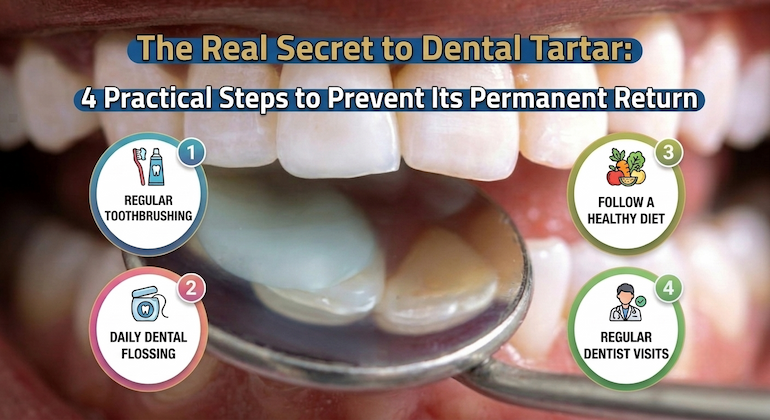
4 Practical Steps to Permanently Prevent Tartar Recurrence
If you’re wondering how to get rid of currently accumulated dental tartar, the definitive medical answer is: you must visit a dental clinic for professional dental tartar cleaning using metal instruments or ultrasonic waves.
To maintain the results and apply the best methods for preventing dental tartar to ensure it doesn’t return, follow this plan:
1. Correct Brushing Twice Daily
Make sure to brush your teeth at least twice a day, especially before bed. Dedicate a full 30 seconds to gently cleaning the inner surfaces of your lower teeth near the gums.
2. Baking Soda Toothpaste
Use toothpaste containing baking soda, as it has a unique ability to break down bacterial film and penetrate tiny crevices that are difficult for a regular toothbrush to reach.
3. Request “Polishing” After Cleaning at the Dentist
When having dental tartar cleaned at the clinic, ask the dentist to polish your teeth well; because the tartar scraping process leaves the tooth with a rough surface that makes it easy for bacteria to re-adhere if it is not smoothed and polished.
💡 Quick Tip for Keto Dieters
If you are following a keto diet, you might notice a slight increase in tartar formation. The reason is that keto reduces oral acidity and makes it more alkaline, which is excellent for preventing cavities, but it might slightly accelerate tartar formation. The solution is not to quit keto, but to strictly adhere to the four steps above!
Discover more from magallati
Subscribe to get the latest posts sent to your email.


